

Recent geopolitical tensions in the Middle East have prompted many investors to reconsider their portfolios. You may be one of them.
And that’s understandable. Geopolitical conflicts can influence energy supply, commodity prices, shipping costs, defense spending, and overall market sentiment. Yet history suggests that abandoning stocks in response to geopolitical fear has rarely been the optimal strategy.
How Markets Typically React to Wars
Looking at more than 25 major military conflicts over the past 70 years, the S&P 500 has historically declined about 4–5% on average, bottoming roughly three weeks after the conflict begins, before recovering within about six weeks, according to LPL Financial Research.
Longer-term outcomes have been even more encouraging. In approximately 70% of cases, the market was higher one year after the start of armed conflict, delivering an average gain of more than 11% in the following 12 months.
The investors who navigate geopolitical turbulence most successfully enter these periods with diversified portfolios, sufficient liquidity, and disciplined investment processes that help them avoid emotionally driven decisions.
Geopolitical Conflicts Have Had Minimal Impact on Long-Term Equity Performance
Growth of $10,000 in the S&P 500 Price Index (1940–2025)
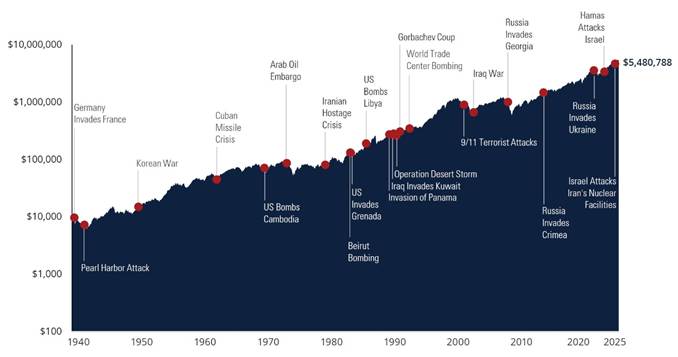
Past performance does not guarantee future results. Indices are unmanaged and not available for direct investment. Data shown does not include the reinvestment of dividend payments. Data Sources: Morningstar, Ned Davis Research, and Hartford Funds, 3/26.
Which Sectors May Benefit or Struggle
During periods of geopolitical tension, certain industries tend to experience stronger or weaker performance:
Potential beneficiaries
- Energy companies
- Aerospace and defense
- Cybersecurity providers
Industries facing pressure
- Global shipping and logistics due to higher insurance and routing costs
- Certain insurers exposed to geopolitical risk
- Industries heavily dependent on energy or global trade flows
However, even if we set aside halal investing criteria, which eliminates defense and insurance as investable sectors, attempting to tactically rotate portfolios into these sectors during crises can be difficult and often leads to poor timing decisions.
The Case for Staying Invested
For most long-term investors, the best defense against geopolitical uncertainty is diversification and discipline.
Research illustrates the importance of remaining invested. A hypothetical $100,000 investment in the S&P 500 in 1988 would have grown to roughly $4.9 million by 2024. Missing just the 10 best market days during that period would have reduced the ending value by more than half.
Market volatility often triggers behavioral biases, particularly loss aversion—the tendency to react more strongly to losses than gains. Herd behavior can amplify this effect, leading investors to sell at the worst possible time.
Practical Portfolio Strategies
Rather than reacting to headlines, investors should focus on maintaining resilient portfolios.
Key strategies include:
1. Geographic diversification
Geopolitical shocks rarely affect all regions equally.
2. Sector diversification
Maintaining exposure across industries such as healthcare, industrials, and energy can help reduce concentration risk.
3. Asset class diversification
A mix of equities, fixed income, and other assets can improve resilience during volatile periods.
Additionally, maintaining several years of anticipated cash needs in lower-volatility assets helps avoid forced selling during downturns. Your Azzad advisor can work with you to find an approach that is consistent with your overall financial plan.
The Bottom Line
Geopolitical events are unsettling, but history suggests that reactive portfolio changes rarely improve long-term outcomes.
Investors who remain disciplined, maintaining diversified portfolios and focusing on long-term objectives, are typically better positioned to weather periods of uncertainty and participate in eventual market recoveries.
Note: Diversification cannot prevent a loss or ensure a gain.
Past performance is not indicative of future results. The material above has been provided for informational purposes only and is not intended as legal, tax, or investment advice or a recommendation of any particular security or strategy. The investment strategy and themes discussed herein may be unsuitable for investors depending on their specific investment objectives and financial situation. Information obtained from third-party sources is believed to be reliable though its accuracy is not guaranteed, and Azzad Asset Management, Inc. makes no representation or warranty as to the accuracy or completeness of the information, which should not be used as the basis of any investment decision. Information contained on third party websites that Azzad Asset Management, Inc. may link to is not reviewed in their entirety for accuracy and Azzad Asset Management, Inc. assumes no liability for the information contained on these websites. Opinions expressed in this commentary reflect subjective judgments of the author based on conditions at the time of writing and are subject to change without notice. No part of this material may be reproduced in any form, or referred to in any other publication, without express written permission from Azzad Asset Management, Inc. For more information about Azzad Asset Management, Inc., including our Form ADV brochures, please visit https://adviserinfo.sec.gov and search for our firm name.