Azzad MarketWeek
Stocks weathered another choppy week, but the major averages ended higher despite week-long attention focused on one of the largest companies in the S&P 500.
Markets also continued to process the midterm election results while geopolitical developments unfolded in the background.
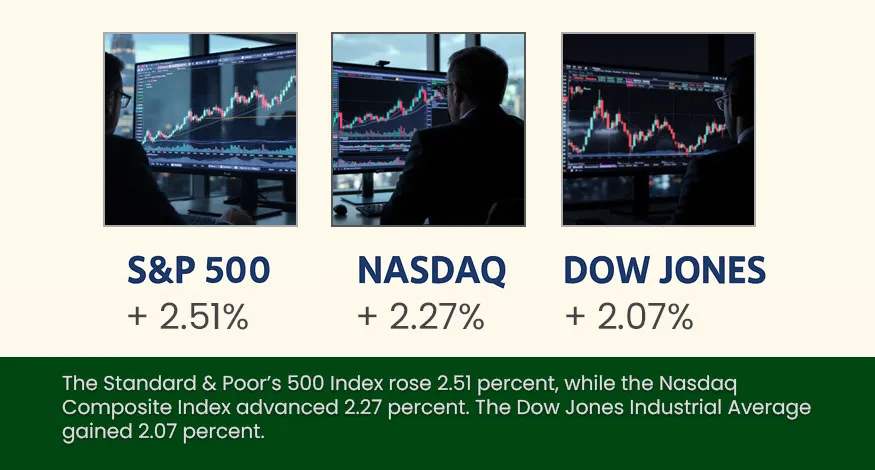
The Standard & Poor’s 500 Index rose 2.51 percent, while the Nasdaq Composite Index advanced 2.27 percent. The Dow Jones Industrial Average gained 2.07 percent.
Rebounding Through the Noise
Stocks started the week with a bounce as oil prices fell, lifting market sentiment in a tech-led recovery as investors looked for opportunities. But after news that the board of directors of a large artificial intelligence (AI) chipmaker announced an investigation into its chief executive officer (CEO), initial enthusiasm was tempered.
Stocks fell on Tuesday as warmer-than-expected inflation data unsettled investors, and comments from a key Fed official further dampened sentiment.
Markets rallied back midweek as one AI company issued a better-than-expected Q3 report and another AI firm gave an update on demand for its coming initial public offering (IPO). Both news items boosted the AI trade, with all three major averages advancing
But markets fizzled over the remaining two trading days after the AI chipmaker’s CEO resigned under pressure, impacting the broader market. But that didn’t stop the Nasdaq from notching its best week since August.
Investing involves risks, and investment decisions should be based on your own goals, time horizon, and tolerance for risk. The return and principal value of investments will fluctuate as market conditions change. When sold, investments may be worth more or less than their original cost.
The forecasts or forward-looking statements are based on assumptions, may not materialize, and are subject to revision without notice.
The market indexes discussed are unmanaged and generally considered representative of their respective markets. Index performance is not indicative of the past performance of a particular investment. Indexes do not incur management fees, costs, and expenses. Individuals cannot directly invest in unmanaged indexes. Past performance does not guarantee future results.
The Dow Jones Industrial Average (DJIA) is a price-weighted index composed of 30 widely traded blue-chip U.S. common stocks. The S&P 500 is a market-cap weighted index composed of the common stocks of 500 largest, publicly traded companies in leading industries of the U.S. economy. The NASDAQ Composite Index is a market-value weighted index of all common stocks listed on the NASDAQ stock exchange. The Russell 2000 is a market-cap weighted index composed of 2,000 U.S. small-cap common stocks. The Global Dow is an equally weighted index of 150 widely traded blue-chip common stocks worldwide. The U.S. Dollar Index is a geometrically weighted index of the value of the U.S. dollar relative to six foreign currencies. Market indexes listed are unmanaged and are not available for direct investment.
Fixed income investments are subject to various risks including changes in interest rates, credit quality, inflation risk, market valuations, prepayments, corporate events, tax ramifications and other factors.
International investments carry additional risks, which include differences in financial reporting standards, currency exchange rates, political risks unique to a specific country, foreign taxes and regulations, and the potential for illiquid markets. These factors may result in greater share price volatility.