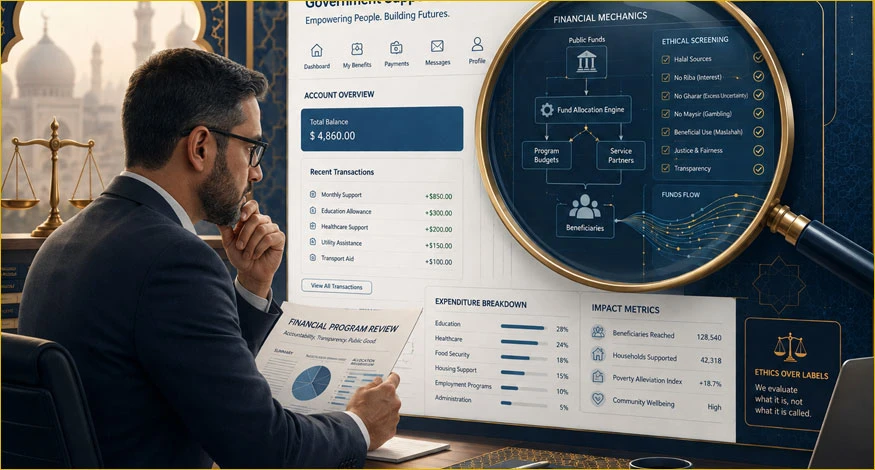


Lately, some of our advisors have noticed an interesting shift in our introductory meetings. Clients and prospective clients are increasingly coming into our offices with halal investing screens, portfolio ideas, or Shariah-compliance checklists that are printouts of ChatGPT output or other AI engines.
These kinds of tools can be great for learning the basics of Islamic finance, breaking down terms like “riba,” “gharar,” and “purification,” and generating immediate answers.
However, seeing these printouts reminds us of a fundamental truth: getting an answer from a computer is entirely different from getting sound, Shariah-informed guidance on managing a halal portfolio.
The Multi-Year Behavior Gap
Technology is exceptional at solving math problems, but it can struggle when asked to manage your emotions, or your iman. Morningstar’s “Mind the Gap” study found that over the decade ending December 2024, the average dollar invested in U.S. funds earned about 1.2 percentage points a year less than the funds themselves returned, mostly because investors bought after securities had risen and sold after they had fallen.1
An AI chatbot can tell you that abandoning a strategy during a period of market volatility may be a mistake. But it may struggle to remind you of “sabr” (patience) and “tawakkul” (trust in God’s plan) when your stomach is in knots and every instinct you have is telling you to get out. Managing wealth the halal way is not an information transaction. Relationships, and shared values, matter.
Quantifying the Human Element
The most-cited research suggests that financial professionals add value, but that value comes from behavior and strategy, not from stock-picking and market timing. Vanguard’s long-running Advisor’s Alpha work estimates financial professionals can add roughly 3 percent in net value, and the single largest component, worth more than 1.5 percent on its own, is behavioral coaching. For a Muslim investor, that coaching carries an added layer: staying disciplined within a Shariah-compliant strategy rather than drifting toward conventional holdings when performance narrows the gap.2
According to the 2026 Employee Benefit Research Institute (EBRI), 83 percent of workers with access to a financial advisor feel confident about their retirement readiness, compared with just 53 percent of those without access. For Muslim families, that confidence often depends on knowing an advisor understands both markets and the deen, someone who can explain why a stock has been screened out, how a purification percentage is calculated, or how zakat applies to a given account, not just what the numbers say. The role of the financial professional appears to be evolving into that of an interpreter, coach, and strategist, and for us, a fiduciary who also adheres to the principles of Islamic finance.3
What the Algorithm Misses
The most important choices in your financial life do not have a single, clean mathematical output. An AI engine can run a quick screen against a company’s debt ratios or interest income, but it will not know that a Shariah Advisory Board recently revised a threshold, that a company’s revenue mix shifted this quarter, or how a shareholder proposal we filed under SEC Rule 14a-8 might change our view of a holding going forward. Zakah calculations, purification percentages, and matters like Islamic inheritance planning require context, scholarship, and a deep understanding of your personal values, not just a query.
Putting Technology to Work for You
We view AI the way we view any screening tool: useful for a first pass, not a substitute for a scholar’s or an advisor’s judgment. We use it to handle data analysis and Shariah-screening groundwork so that we can dedicate more of our time to you. You do not partner with us just for calculations; you partner with us for human judgment, Islamic financial literacy, and a steady hand when the headlines get loud.
Our focus remains entirely on building and managing a halal strategy tailored to your life goals, and your “akhirah.” If you ever want to review your current portfolio strategy, ask whether an investment fits your Shariah requirements, or if you have run some scenarios through an AI engine and the results raised some questions, please let us know.
We are always here to talk it through.
1. Morningstar.com, November 7, 2025.
https://www.morningstar.com/podcasts/investing-insights/investors-still-need-mind-gap-their-funds-returns
2. Vanguard.com, 2026.
https://advisors.vanguard.com/advisors-alpha
3. EBRI.org, 2026.
https://www.ebri.org/retirement/retirement-confidence-survey